Industrial Equipment Troubleshooting: Common Electrical Issues and Solutions
When industrial equipment goes down, the problem rarely stays small for long. One tripped breaker can stop a conveyor. One overheating motor can slow production across an entire line. One loose connection inside a control panel can create intermittent faults that eat up hours of labor before anyone even finds the root cause. In industrial facilities, electrical problems have a way of multiplying. What starts as a flicker, a nuisance trip, or an unexplained shutdown can turn into lost production, damaged equipment, and real safety risks.
That is why industrial electrical troubleshooting matters so much. It is not just about getting a machine running again. It is about identifying the underlying issue, correcting it safely, and preventing the same failure from happening again next week. At Compass Electrical Solutions, we work with industrial clients across the St. Louis region to diagnose electrical issues, support preventive maintenance efforts, and deliver reliable solutions that keep facilities operating with less downtime and fewer surprises.
Why Industrial Electrical Troubleshooting Requires a Different Approach
Industrial systems are more complex than standard commercial or residential electrical systems. You are often dealing with heavy equipment, three-phase power, motor controls, PLCs, VFDs, control wiring, HVAC control systems, and interconnected production equipment. When one component fails, the symptoms may show up somewhere else entirely. The fault is not always where the pain is.
That is what makes industrial equipment troubleshooting different. A blown fuse may be obvious, but the reason it blew may not be. A motor overload may trip repeatedly, but the real cause could be voltage imbalance, mechanical binding, poor ventilation, or a failing starter. Effective troubleshooting takes more than swapping parts until something works. It takes a methodical process, field experience, and a clear understanding of how industrial electrical systems behave under real operating conditions.
Power Quality Problems
Power quality issues are one of the most common causes of industrial electrical problems, and they are also some of the easiest to overlook. Equipment may appear to be functioning, but if the incoming power is unstable, dirty, or inconsistent, motors, drives, controls, and sensitive electronics can all start acting unpredictably. The symptoms can be subtle at first: nuisance tripping, overheating, random resets, communication errors, or reduced equipment life.
In industrial environments, power quality problems may involve voltage sags, surges, harmonics, phase imbalance, or poor grounding. Think of it like trying to run a marathon while breathing through a straw. The system may still move, but it is under stress the whole time. Troubleshooting these issues often involves load analysis, voltage testing, thermal imaging, and inspection of service equipment, panels, and grounding systems. If the problem is recurring, it usually points to a larger system condition rather than a one-time event.
Common signs of power quality issues
One of the first signs is equipment that trips or shuts down without an obvious mechanical failure. Variable frequency drives may display fault codes. Motors may run hotter than expected. Lighting in industrial spaces may flicker when large equipment starts. Operators may notice that certain machines fail only during peak usage periods or when other equipment cycles on.
These are the kinds of patterns that matter during industrial electrical troubleshooting. A single event may look random. A pattern tells a story. When troubleshooting industrial equipment, electricians need to look at the broader electrical environment, not just the affected machine.
Overloaded Circuits and Undersized Electrical Infrastructure
Many industrial buildings in the St. Louis area have grown in phases. A facility starts with one use, then adds equipment, changes production lines, expands offices, installs new HVAC loads, or incorporates automation over time. The electrical infrastructure, however, does not always keep pace. Panels that were once adequate become crowded. Feeders that were fine ten years ago are now carrying far more load than they were designed for.
Overloaded circuits can cause breakers to trip, conductors to overheat, and equipment performance to suffer. In some cases, the issue is obvious. In others, it shows up as a low-level chronic problem that gets written off as “that machine being finicky.” But electrical systems are not moody. If something is acting up repeatedly, there is usually a reason.
How overloaded systems show up in industrial settings
You may see breakers tripping during startup, especially when motors or compressors kick on. Control panels may feel hot. Wiring insulation may show signs of age or heat stress. Equipment may run properly during some shifts but struggle when the full production load is active. That is often a clue that the system is being pushed too hard.
The solution may involve redistributing loads, upgrading panels, replacing feeders, or evaluating whether the service capacity matches the current demands of the facility. Good troubleshooting does not stop at resetting the breaker. It asks why the breaker tripped in the first place and whether the system is still built for the work it is being asked to do.
Motor Failures and Motor Control Issues
Motors do the heavy lifting in industrial facilities, and when they fail, production can stall fast. But motors rarely fail in isolation. The motor itself may be the casualty, while the real problem lies in the power supply, control circuit, overload protection, bearings, alignment, or connected mechanical load. Replacing a motor without diagnosing the cause is like replacing tires on a truck with a bent axle. You might get moving again, but not for long.
Industrial motor troubleshooting usually starts by separating electrical issues from mechanical ones. Is the motor receiving proper voltage? Is there phase loss or imbalance? Is the overload relay sized correctly? Is the starter functioning properly? Is the motor winding compromised? Or is the motor fighting a mechanical restriction that is causing excessive current draw?
Warning signs of motor-related electrical issues
A motor that hums but does not start, trips overloads, runs hot, smells burnt, or operates inconsistently all deserves immediate attention. Bearings, belts, shafts, and driven equipment should also be inspected because electrical symptoms often overlap with mechanical resistance. In industrial environments, the line between electrical and mechanical troubleshooting is not always neat.
A good electrician approaches the problem with discipline. Meter readings, insulation testing, amp draw comparisons, control circuit checks, and visual inspection all play a role. In many cases, the most expensive mistake is assuming the first visible failure is the only one.
Faulty Control Wiring and PLC Communication Problems
Control wiring issues can be some of the most frustrating problems in industrial equipment troubleshooting because they often create intermittent faults. Everything works during testing, then fails during production. The machine resets itself. A signal drops out. A relay does not pull in when it should. The problem disappears when the panel door is open and comes back when the line is running. These are the electrical ghosts that waste entire afternoons.
In industrial facilities, control systems are often exposed to vibration, dust, heat, moisture, and years of modifications. A loose terminal, damaged conductor, mislabeled wire, failing relay, or compromised communication cable can create a chain reaction of false signals and inconsistent operation. PLCs and automated systems depend on clean, reliable inputs and outputs. If the wiring is unstable, the logic can only do so much.
Why intermittent faults are so difficult to diagnose
Intermittent problems are difficult because they do not always fail on command. They may appear only when equipment reaches a certain temperature, when vibration increases, or when a specific sequence occurs. That is why industrial electrical troubleshooting often requires patience, documentation, and a step-by-step process rather than guesswork.
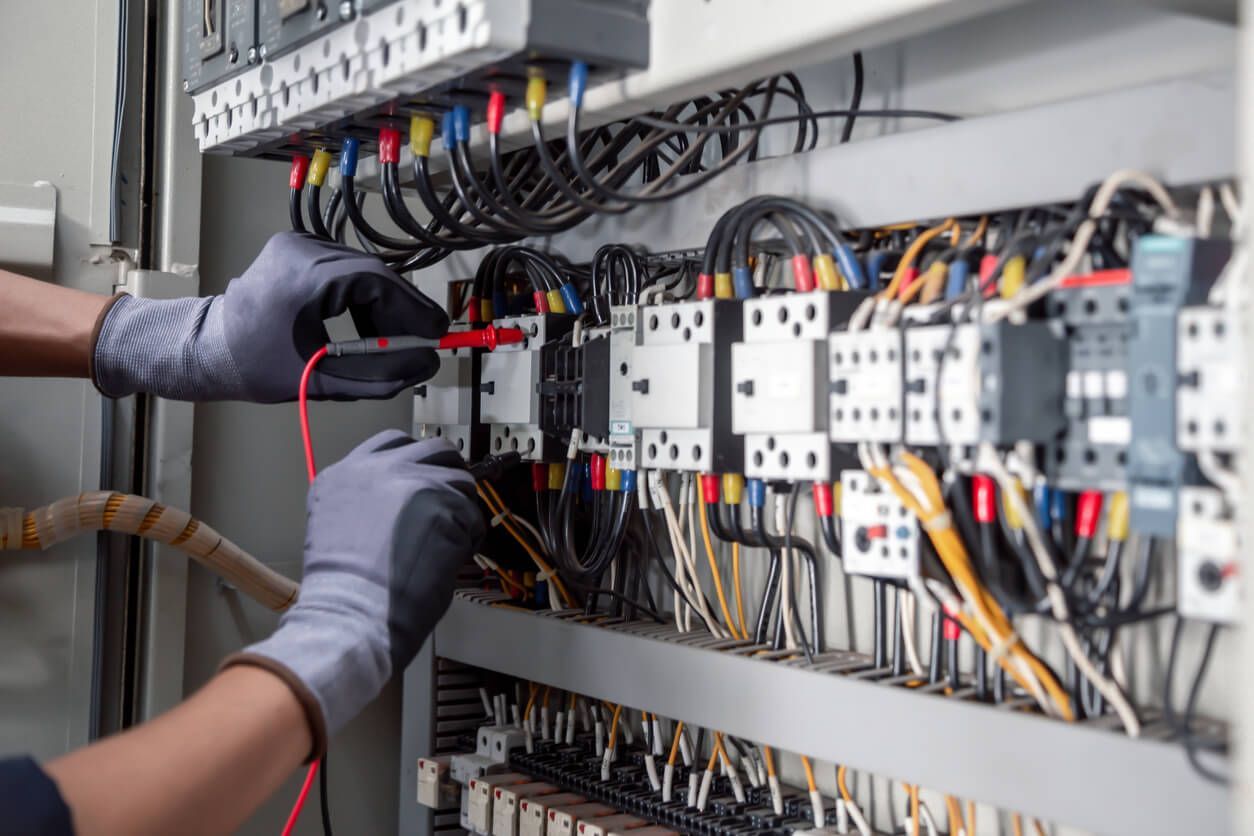
Electricians troubleshooting control systems may inspect terminations, verify voltage at key points, review wiring diagrams, test relays and contactors, and trace communication pathways. In many cases, the issue comes down to something small but critical: a loose neutral, a damaged cable jacket, a corroded terminal, or a field modification that was never properly documented.
Ground Faults and Short Circuits
Ground faults and short circuits are among the most serious electrical issues in industrial settings because they can create both immediate shutdowns and significant safety hazards. A direct short may trip protection devices instantly. A ground fault may be more subtle, especially if it develops gradually due to insulation breakdown, moisture intrusion, or damaged cabling.
Industrial facilities are hard on electrical systems. Equipment moves. Forklifts hit conduit. Washdown areas introduce moisture. Outdoor installations deal with heat, cold, and weather. Over time, insulation weakens, seals fail, and conductors become vulnerable. The result can be anything from repeated breaker trips to dangerous fault conditions inside equipment or panels.
What causes ground faults in industrial environments
Common causes include damaged insulation, wet enclosures, deteriorated motor windings, pinched conductors, failed heaters, and compromised field wiring. Sometimes the fault is obvious, like a visibly damaged cable. Other times it takes systematic isolation testing to locate the problem.
Troubleshooting these conditions safely is essential. The goal is not just to restore power but to identify the full extent of the damage and verify that the system is safe to re-energize. In industrial work, rushing this step can create bigger failures later or put workers at risk.
Failing Panels, Breakers, and Disconnects
Industrial electrical equipment ages, even when it looks fine from the outside. Panels, breakers, disconnects, and switchgear can all degrade over time due to heat, dust, vibration, moisture, corrosion, and repeated operation. A breaker that does not trip when it should is dangerous. A breaker that trips too often without cause is disruptive. Either way, aging power distribution equipment deserves attention.
Sometimes the issue is visible during inspection: discoloration, arcing, pitted contacts, loose lugs, or heat damage. Other times, the warning signs show up in operation. Equipment loses power intermittently. Certain disconnects feel hot. Breakers trip under normal load. Maintenance staff notice buzzing, humming, or the unmistakable smell of overheated electrical components. That smell is never a suggestion. It is a warning.
When electrical distribution equipment should be evaluated
If a facility has expanded its load, experienced repeated nuisance trips, or is relying on older panels and disconnects, it is worth having the system evaluated. Preventive maintenance and testing can catch issues before they become failures. Thermal imaging, torque checks, load balancing, and inspection of panel interiors can reveal problems that are invisible from the outside.
For many industrial clients, troubleshooting leads naturally into upgrades. Once the root cause is identified, the right long-term solution may involve panel replacement, breaker replacement, service upgrades, or reconfiguration of the electrical distribution system.
Preventive Maintenance Is Troubleshooting Before the Failure
The best industrial electrical troubleshooting is often the troubleshooting that happens before production stops. Preventive maintenance gives facility managers and operations teams a chance to find loose connections, overloaded circuits, failing components, and abnormal heat patterns before those issues turn into emergency calls.
This matters even more in industrial environments where downtime is expensive and schedules are tight. A planned service visit is far easier to manage than a midnight shutdown with a line full of unfinished product. Preventive maintenance is not glamorous, but neither is losing an entire shift because a problem that could have been caught early was allowed to grow teeth.
What preventive maintenance can help identify
Routine inspections and testing can uncover deteriorating breakers, weak terminations, control issues, voltage irregularities, motor problems, and safety concerns. It also gives electricians a chance to understand how the facility is operating now, not just how it was designed years ago.
For industrial companies in St. Louis, especially those working in manufacturing, warehousing, processing, or distribution, regular electrical maintenance is one of the most practical ways to reduce downtime and improve reliability. It is not just maintenance for maintenance’s sake. It is a strategy for protecting production.
When to Call an Industrial Electrician
Some electrical issues are obvious emergencies. Smoke from a panel, repeated breaker trips, equipment that will not restart, exposed damaged wiring, or a generator or transfer issue tied to critical operations all need prompt professional attention. But many industrial problems start quietly. That is where experience matters.
If your facility is dealing with unexplained shutdowns, inconsistent equipment behavior, motor failures, recurring control issues, power distribution concerns, or aging electrical infrastructure, it is time to bring in an industrial electrician who can troubleshoot the system properly. Industrial electrical troubleshooting is not a guessing game, and it should never be treated like one.
At Compass Electrical Solutions, we provide industrial electrical services throughout the St. Louis region, including troubleshooting, control wiring, PLC-related support, testing services, preventive maintenance, panel upgrades, and broader industrial electrical work. Our team takes a consultative, practical approach focused on safety, reliability, and long-term performance.
Reliable Troubleshooting for Industrial Facilities in St. Louis
When electrical issues interrupt production, you need more than a temporary fix. You need a team that can diagnose the problem, explain what is happening, and implement a solution that holds up under real operating conditions. That means looking beyond the symptom, understanding the system, and doing the work correctly.
Compass Electrical Solutions helps industrial clients across St. Louis solve electrical problems with the urgency, professionalism, and attention to detail these environments demand. If your facility is dealing with recurring faults, equipment shutdowns, power quality issues, or aging electrical components, contact our team to schedule industrial electrical troubleshooting and service. We are here to help keep your operation running safely, efficiently, and with fewer costly surprises.
RECENT POSTS